I’ve been following Rach Stewart, Lee Cook and Daniel Murray on social media for a few years now and have gotten to know and love their photography styles. Without even meeting them and just seeing their photos, I already had learnt so much from them.
Rach is who inspired me to explore long exposure. Just adding that element to my photos has made a world of difference, and I’m addicted. Her photography is as humble as she is, and truly breathtaking. Just when you think her photography can’t get any better, it does. I would be lying if I said I wasn’t star struck when I met Rach.
Lee is exceptional at astrophotography. I admire his talent and enthusiasm for adventure so so much. If you know me personally, you’ll know my love for aviation and aerospace, so this part of the workshop, learning from the best, was right up my alley. I can only ever hope to experience the level of photography Lee has and see the things that he has seen.
Daniel is superb with landscapes and knows the Canterbury region, and the South Island for that matter, inside and out. His work on the Hurunui – Kaikoura earthquake recovery project is very inspiring, and his dedication shows through his photography. He always spoke highly of his family, and I loved that about him and how proud he is.
The three of them are all so different, but they all share the same love and passion when it comes to photography.
Day 1:
We met at Christchurch airport and made the beautiful 3-hour drive to Tekapo. Driving into Tekapo and seeing that gorgeous blue water for the first time was just stunning. Our accommodation was perfectly located in the centre of town, had epic views of the lake and mountains and was a short walking distance into the village. After checking in, we had a meeting providing an overview of what to expect over the next few days.
Andrew from Nisi Filters, who was with us for the first 2 days, gave us Nisi filter training and let us know the filters he had on offer for us to use throughout the trip. There was also a large selection of cameras and lenses we could use and take advantage of throughout the workshop too.
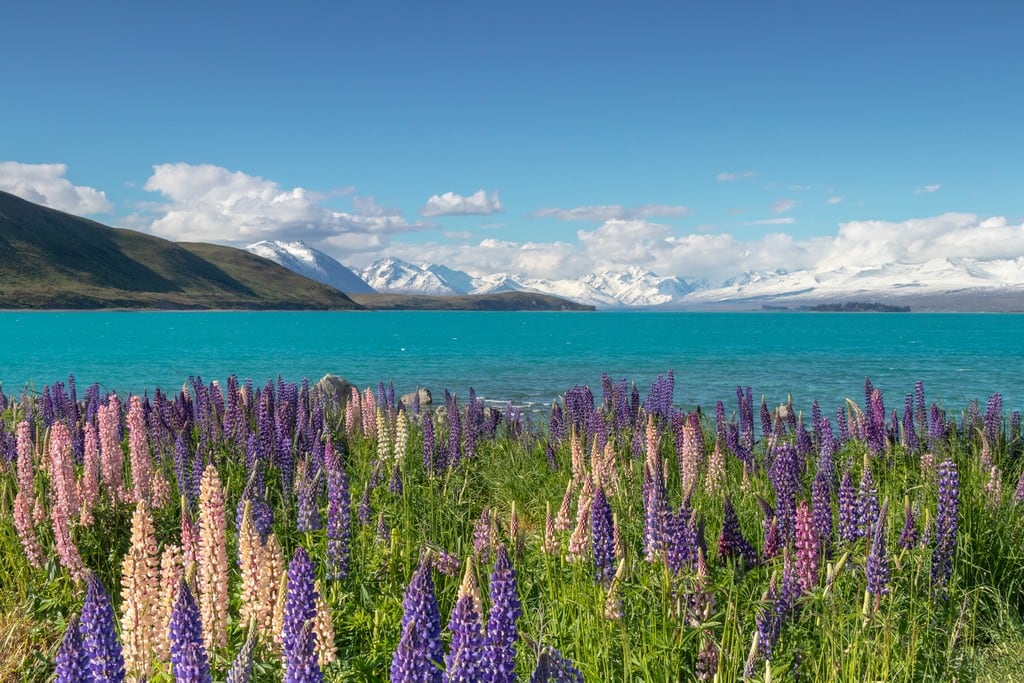
The first location shoot was down at Lake Tekapo with the lupins. It had been snowing for a couple of days before we arrived, so the mountains were covered in white powder. Everyone set up and began shooting, and I was overwhelmed with what to do, how to do it, and where to even begin. I just looked at my camera and was lost. Andrew noticed and came to spend a lot of time with me and started from the beginning. He showed me settings on my camera, went through aperture and compositions with me and set me off on the right foot. The guy has the patience of a saint (they all do actually). I asked the same questions a million times over, but he never made me feel any less for it.
 We spent a good few hours in this spot. I never knew I could learn so much in those few hours. After, we headed off to dinner, then went back out to shoot the sunset on the other side of the lake, and wow, what a stunner it was! It was a crisp clear evening, the sky turned pink and purple, the lupins were in full bloom and the full moon was rising. It was a perfect setting.
Tonight was the night we also got to try astrophotography. We headed to the Church of the Good Shepard for this astro session. I had absolutely no clue on what to do, but Lee took me under his wing the entire time we were there and mentored me. The PhotoPills app showed us exactly where the Milky Way was, where the core of the Milky Way would be, the direction and height of it and when the sun and moon will rise and set. Lee showed me how to calculate the shutter speed time, how to use bulb mode on my camera with and without a remote, how to do star trails, what ISO to use, the list goes on. It was a full moon that night so the sky was bright, but we managed to get a few shots above the church, down by the waterfront and do some star trails. Truly magical.
 Unfortunately this was the only night we got to do astro as the weather wasn’t in our favour, but just this experience alone of capturing the night sky was seriously something I will never forget. Even though I literally had no idea of what to do, I really felt like I was in my element and hope I can follow this passion of astro – this is what I want to do. Lee if you’re reading this, you inspired me so much that night, so much so that I’ve booked in for an astro workshop in my local area during the Milky Way season.
Day 2:
The weather for the end of the trip was forecasted to not be as great as day 1, so the sunrise flight with Air Safaris over Mt Cook was brought forward to this morning, and I’m so glad it was. The conditions were perfect to go above the clouds and watch the sun hit the mountains. This was one of the highlights of my trip. The hour long flight took us over the Southern Alps, Tasman Valley, Mt Tasman and, of course, Mt Cook, all dipped in snow. Flying over the lakes and seeing the river braids was a pretty cool experience, and even though we only had a few hours sleep beforehand, it was well worth getting out of bed for. Daniel helped a lot pre-flight with camera settings and shared his knowledge on how to approach low light and not get the glare from the sun through the aircraft window. Wearing dark clothes also helps, I was told.
After brekky, we headed to the Pukaki Canals and began shooting around the lupins before heading off to Twizel for the afternoon. Mt Cook was peaking through the clouds, and we shot her in all her glory before heading off to Lake Ohau. The weather was fading on us, but it was an excellent opportunity for some moody shots with the lupins and mountains. The water was crystal clear and made for some good compositions with the rocks in the water and the dark clouds in the distance – Daniel and Lee both helped me with this. Along the other end of the lake were the lupins which really brought out the foreground. I learnt a lot here. I learnt to use the weather as a positive and use the clouds to my advantage. I also learnt that a landscape doesn’t always have to be shot in landscape and something as simple as making it portrait can change the photo entirely, for the better.
The clouds were well and truly setting in, but the tutors made amendments to the itinerary where need be and always had our best interests at heart when taking us to the different shooting locations. There wasn’t much of a sunset on this night, but the scenery and fresh air were still amazing.

Day 3:
There was an optional sunrise session this morning, if you wanted to try your luck with the weather. A slight detour in the itinerary took us to a lookout point where we gazed across Lake Tekapo to Motuariki Island. I spent some time with Rach here exploring my camera a bit more. I really liked her approach and helping me understand even the simplest things about photography. Even though we have different cameras, she could easily point me in the right direction on mine and what needed tweaking. Again, I asked the same questions, but I was definitely gaining more confidence with what I had learnt so far during the trip. We then drove up to the top of the Tekapo Star Gazing site and took in the views and watched those big black clouds in the distance to where we were meant to go next.

Once again, the weather was not cooperating, so our hike to Mt Cook along the Hooker Valley Track got cancelled, but we braved the rain and low cloud and headed to Tasman Lake. And wow, it was amazing!!! I was like a kid on Christmas morning when I got to the end of the track and saw icebergs in the lake for the first time. I don’t think any pictures can do this place justice, you just need to see it to believe it. At first, I found it hard for compositions here, but this was only because it was just so beautiful and was so excited to see the icebergs. Wanting to photograph everything at once, I just needed to take it all in and soak it up for a bit, then capture it the best that I could. The rain held off while we were there, so we were quite fortunate for that. You can’t control the weather, but you can control how you deal with it. I now understand that bad weather isn’t necessarily a bad thing at all.
Safe to say there was no sunset tonight, but that was ok. I was pretty stoked with Tasman Lake, another highlight of the trip.
Day 4:
There was another optional sunrise this morning before checking out of our rooms. Before saying goodbye and going our separate ways, we were given an overview on how to edit photos using Lightroom. This was also a good chance for us to talk to the tutors about our photos and hear their suggestions on what we could modify, if need be, for the overall finishing touches.
Most of us split up and continued on with our travels, and some of us caught the bus back to Christchurch and finished up there.
There were so many things that stuck out on this workshop and why I loved it so much. The main one being that we actually got to spend time at each location and not just take a few snaps and continue on to the next spot. I didn’t feel rushed and could appreciate my surroundings, whilst also learning from some of the best photographers in New Zealand. The locations we were taken to were incredible, no matter the weather, and best of all, they are all in the country I now call home.
There were all levels of photographers who joined me on this tour, and all 10 of us had one-on-one tutoring in the field from Rach, Daniel, Lee and Andrew. Knowing I had access to their expert knowledge throughout the workshop made me even more determined to learn. I didn’t want to walk away empty handed, and I didn’t want to be better than anyone else. I just wanted to be a better photographer than what I was at the beginning of this.
The photography tour I did was the spring Lakes & Lupins one in November 2018. To learn more about all the different workshops available, check out Pure Photo Adventures.